Cistern Dimensions (Metric)
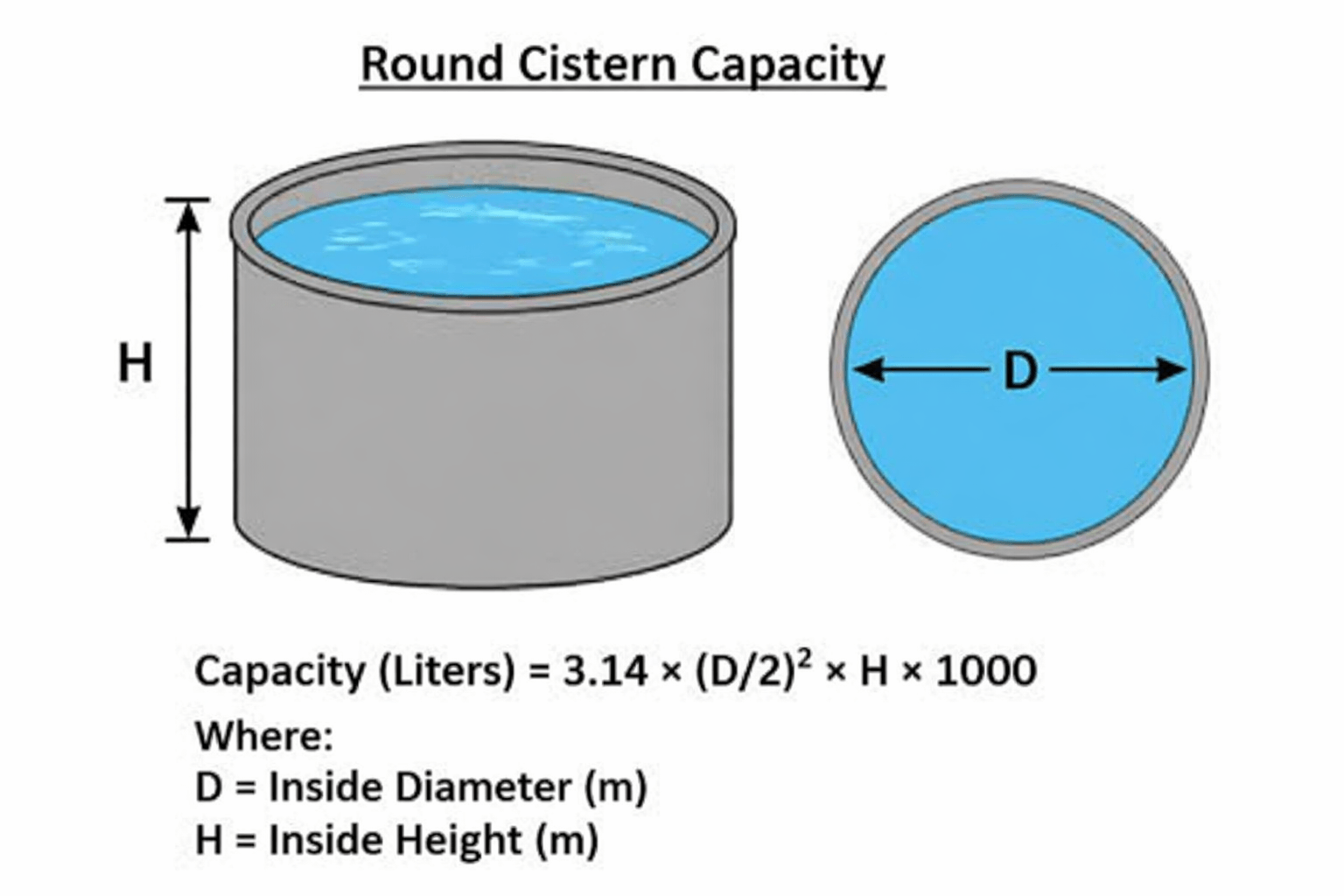
Professional Round Cistern Capacity Diagram | Metric Volume Reference
Rainwater Harvesting Guide (Metric)
Each millimeter of rain on 1 square meter of roof yields exactly 1 liter of water. The formula is:
Annual Collection (liters) = Roof Area (m²) × Annual Rainfall (mm)
For example, a 150 m² roof in an area with 800 mm annual rainfall can collect up to 120,000 liters per year. A 10,000 liter cistern would fill about 12 times annually.
Roof Area Reference Table
| House Size | Typical Roof Area (m²) | Rainfall 500mm | Rainfall 800mm | Rainfall 1000mm |
|---|---|---|---|---|
| Small (2-3 bedroom) | 80-100 | 40,000-50,000 L | 64,000-80,000 L | 80,000-100,000 L |
| Medium (3-4 bedroom) | 120-150 | 60,000-75,000 L | 96,000-120,000 L | 120,000-150,000 L |
| Large (5+ bedroom) | 180-250 | 90,000-125,000 L | 144,000-200,000 L | 180,000-250,000 L |
Cistern Sizing Guide (Metric)
Recommended cistern sizes based on household needs:
| Household Size | Daily Usage (liters) | Recommended Cistern Size | Days of Backup |
|---|---|---|---|
| 1-2 people | 200-300 L | 3,000 - 5,000 L | 10-20 days |
| 3-4 people | 400-600 L | 5,000 - 10,000 L | 10-15 days |
| 5-6 people | 600-900 L | 10,000 - 15,000 L | 10-15 days |
| 7+ people | 900-1200 L | 15,000 - 25,000 L | 12-20 days |
Common Round Cistern Sizes (Metric)
| Diameter (m) | Height (m) | Volume (liters) | Volume (kL) | Typical Use |
|---|---|---|---|---|
| 1.5 | 1.5 | 2,650 | 2.65 | Small garden |
| 2.0 | 2.0 | 6,283 | 6.28 | Small household |
| 2.5 | 2.5 | 12,272 | 12.27 | Average household |
| 3.0 | 3.0 | 21,206 | 21.21 | Large household |
| 3.5 | 3.5 | 33,673 | 33.67 | Farm / commercial |
| 4.0 | 4.0 | 50,265 | 50.27 | Large commercial |
How to Use This Metric Cistern Calculator
- Step 1: Enter the diameter of your round cistern (in meters or centimeters).
- Step 2: Enter the height/depth of your cistern.
- Step 3: Select your input unit (meters or centimeters).
- Step 4: Set the fill level percentage (default 100% for full capacity).
- Step 5: Choose your usage type to see estimated days of supply.
- Step 6: Click "Calculate Cistern Capacity" for instant results.
Results are displayed in liters, kiloliters (kL), and cubic meters (m³) — perfect for metric system users worldwide.
The Formula Explained
For a cylindrical cistern, the volume is calculated using the formula for a cylinder:
V (m³) = π × r² × h
To convert cubic meters to liters: Liters = m³ × 1000
Where:
- π = 3.14159
- r = radius = diameter ÷ 2 (in meters)
- h = height (in meters)
If you're using centimeters, convert to meters first (divide by 100) or use: Liters = π × r(cm)² × h(cm) ÷ 1000
Why Accurate Round Cistern Capacity Matters
I've worked on countless rainwater harvesting projects where underestimating cistern capacity caused major problems - from running out of water during dry spells to installing tanks that were too small for the intended use. That's exactly why I built this round cistern capacity calculator - to help homeowners, farmers, and engineers get their water storage calculations right the first time.
Whether you're planning a rainwater collection system in metric units (meters, centimeters), sizing a backup water supply for your home, or designing irrigation storage, knowing your exact cistern capacity in liters, kiloliters, or cubic meters changes everything.