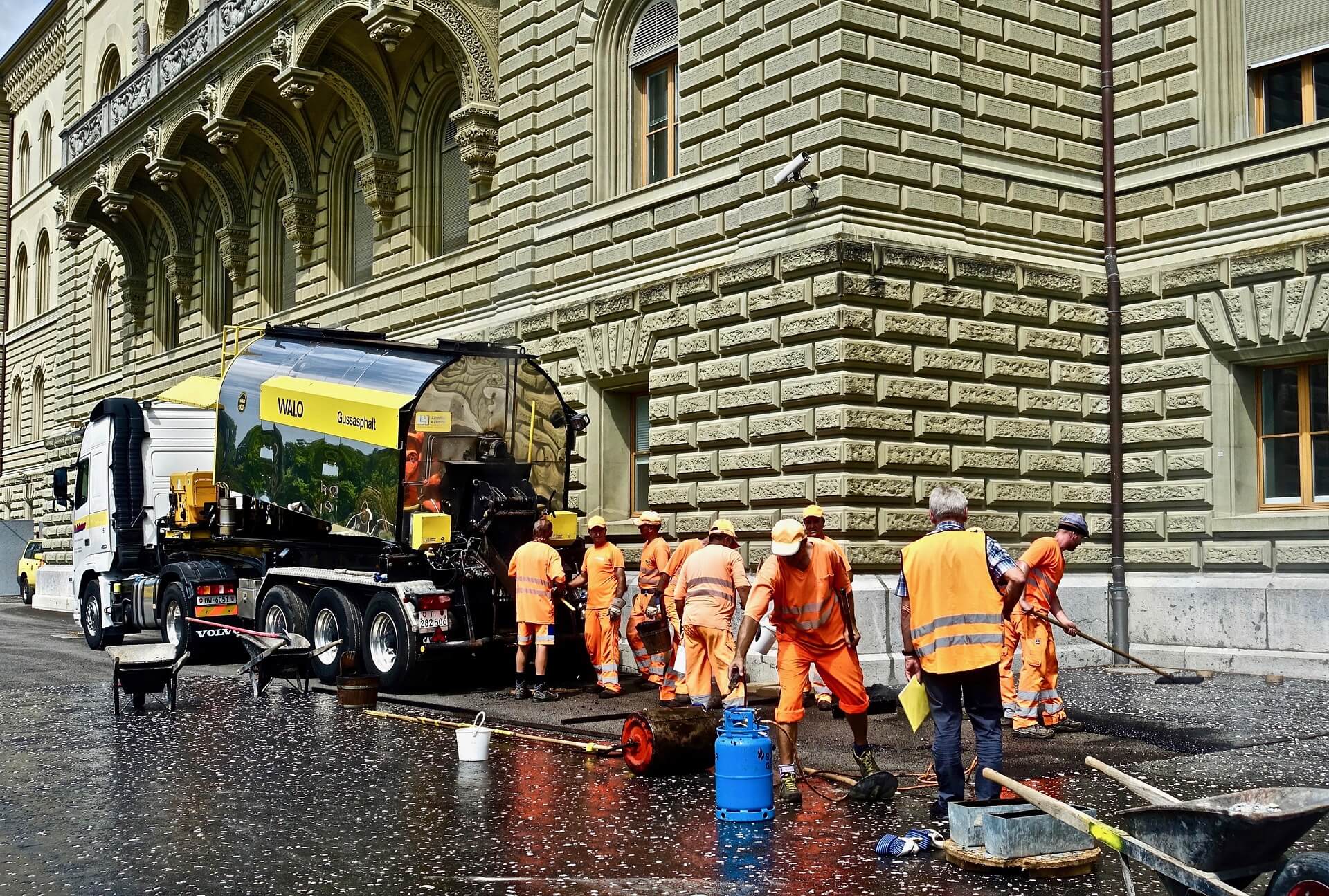
Bitumen: The Professional Guide to Binder Properties, Quantities, and Calculations
What Is Bitumen?
In civil engineering and pavement construction, bitumen is a black, sticky, and highly viscous liquid or semi-solid form of petroleum. It is classed as a pitch and can be found in natural deposits, though it is more commonly the result of professional petroleum refinement. Often referred to as "asphalt binder" in North American terminology, bitumen serves as the primary "glue" that binds mineral aggregates together to create durable surfaces. Its unique properties, including water resistance, durability, and high traction, make it an indispensable material for infrastructure projects ranging from massive highway networks to residential driveways.
Bitumen vs. Asphalt: What Is the Difference?
While the terms are often used interchangeably in casual conversation, they represent distinct components in engineering specifications. Bitumen is the viscous petroleum-derived binding agent. Asphalt (or asphalt concrete) is the finished composite material produced by mixing bitumen with aggregates such as crushed stone, sand, and mineral filler. In simpler terms, if a pavement is a "cake," bitumen is the "syrup" that holds the "flour and nuts" (aggregates) together. Furthermore, bitumen is distinct from tar; while asphalt uses bitumen as a binder, original Tarmac utilized coal tar as the binding agent.
Common Types and Grades of Bitumen
Bitumen is formulated into various types and grades to suit specific climate conditions and application methods.
- Hot Mix Asphalt (HMA) Binders: These are heated at high temperatures during production to reduce viscosity and remove all moisture prior to mixing.
- Bitumen Emulsions: These consist of bitumen dispersed in water with an emulsifying agent. A common grade is Cationic Bitumen Emulsion (SS1), which is frequently used for prime coats.
- Cutback Bitumen: This is bitumen "cut" with a solvent (like kerosene) to make it liquid at lower temperatures. Common grades include MC 30 and MC 70.
- Polymer Modified Bitumen (PMB): Bitumen enriched with recycled polymers (such as rubber tires) to enhance elasticity and durability for heavy-duty applications like airfields or high-traffic motorways.
Bitumen Properties and Characteristics
The technical performance of a road depends on the inherent characteristics of the bitumen binder:
- Viscosity: Bitumen is highly viscous, meaning it resists flow, though this viscosity decreases significantly when heated.
- Adhesion: It provides the necessary bondage of aggregates, ensuring the structural integrity of the pavement.
- Waterproofing: Bitumen is non-porous and has high waterproofing capability, protecting the underlying subgrade from water infiltration.
- Flexibility: Unlike rigid cement concrete, bituminous pavements are considered flexible when cured, allowing them to withstand soil movement and thermal expansion without brittle failure.
Composition of Asphalt Concrete
      [ AGGREGATE SKELETON ]         [ BITUMEN BINDER ]
          (Stone & Sand)         +    (Liquid Petroleum)
                |                       |
                +-----------+-----------+
                            |
                 [ FINISHED ASPHALT MIX ]
             (Flexible, Waterproof Surface)
Bitumen Density and Weight
Density is the critical variable used to convert bitumen volume into weight for procurement and batching.
- Mix Density: For standard Hot Mix Asphalt, the industry standard density used for estimation is $145\text{ lb/ft}^3$ ($2,322\text{ kg/m}^3$).
- Pure Bitumen Weight: Bitumen typically accounts for a small percentage of the total mix weight. For example, one tonne of finished asphalt contains approximately 55 kg of bitumen when using a 5.5% binder content.
Bitumen Units and Measurement Conversions
Precision in unit usage is mandatory to avoid "massive estimation errors".
| To Convert From | To | Operation |
|---|---|---|
| Square Meters ($\text{m}^2$) | Square Feet ($\text{ft}^2$) | Multiply by 10.7639 |
| Kilograms ($\text{kg}$) | Tonnes ($\text{t}$) | Divide by 1,000 |
| Inches ($\text{in}$) | Feet ($\text{ft}$) | Divide by 12 |
| US Short Ton | Pounds ($\text{lbs}$) | 2,000 lbs |
| Metric Tonne | Kilograms ($\text{kg}$) | 1,000 kg |
How to Calculate the Amount of Bitumen Required
Calculating bitumen requirements involves a multi-step engineering chain: Dimensions $\rightarrow$ Volume $\rightarrow$ Total Weight $\rightarrow$ Bitumen Content.
The Core Formula for HMA
To find the weight of bitumen in an asphalt layer:
$$\text{Bitumen Weight} = (\text{Area} \times \text{Thickness} \times \text{Mix Density}) \times \left(\frac{\text{Bitumen \%}}{100}\right)$$
Bitumen Quantity per Square Unit (Surface Dressings)
For surface applications like a Prime Coat, the quantity is calculated based on a "Rate of Spray".
$$\text{Quantity of Bitumen (kg)} = \text{Total Area (m}^2\text{)} \times \text{Rate of Spray (kg/m}^2\text{)}$$
Bitumen Content in Asphalt Mixes
The amount of bitumen required varies significantly depending on the intended use and the specific mix design.
| Mix Type | Typical Bitumen Content (%) | Common Use Case |
|---|---|---|
| Dense-Graded HMA | 5.0% – 6.5% | General roads and wearing courses |
| Stone Mastic (SMA) | 6.0% – 7.5% | High-traffic motorways and arterials |
| Open-Graded (OGFC) | 4.5% – 6.0% | Noise-reducing and drainage layers |
| Porous Asphalt | 4.0% – 6.5% | Permeable pavements and eco-parking |
| Polymer Modified | 5.5% – 7.0% | Heavy-duty freight and airfields |
Factors That Affect Bitumen Requirements
- Aggregate Gradation: Mixes with more "fines" (sand and filler) have a higher surface area and require more bitumen to coat every particle.
- Traffic Load: High-traffic areas often utilize a higher bitumen percentage or polymer-modified grades to increase durability.
- Climate: In "freezing climates," bitumen must be resilient enough to handle freeze-thaw cycles without cracking.
- Surface Porosity: When applying a prime coat, porous granular surfaces (like Crusher Run Macadam) require a higher rate of spray (0.9–1.2 $\text{kg/m}^2$) than more compact bases.
How Temperature Affects Bitumen
Temperature is the most significant environmental factor in bitumen performance.
- Application: Bitumen should generally not be applied if the ambient temperature is below $10^\circ\text{C}$ ($50^\circ\text{F}$).
- Viscosity: Bitumen must be heated to high temperatures (Hot Mix) to become a "viscous fluid" that can be easily spread and compacted.
- Curing: A primed surface requires at least 24 hours to cure, allowing moisture and volatiles to evaporate before the next layer is laid.
Worked Example: Calculating Bitumen Quantity
Scenario: A contractor needs to pave a road section 1,000 meters long and 3.5 meters wide with a 50 mm (0.05 m) compacted thickness. The mix design specifies a 5.5% bitumen content and a mix density of $2,350\text{ kg/m}^3$.
- Calculate Volume: $$1,000\text{ m} \times 3.5\text{ m} \times 0.05\text{ m} = \mathbf{175\text{ m}^3}$$
- Calculate Total Mix Weight: $$175\text{ m}^3 \times 2,350\text{ kg/m}^3 = \mathbf{411,250\text{ kg}}\quad (\text{or } 411.25\text{ tonnes})$$
- Calculate Bitumen Weight: $$411,250\text{ kg} \times \left(\frac{5.5}{100}\right) = \mathbf{22,618.75\text{ kg}}\quad (\approx 22.62\text{ tonnes})$$
- Isolate Aggregate Weight: $$411.25\text{ tonnes} - 22.62\text{ tonnes} = \mathbf{388.63\text{ tonnes}}$$
Tonnage Calculation Flow
  [ LENGTH ] x [ WIDTH ] x [ THICKNESS ] = [ VOLUME ]
                                               |
             [ VOLUME ] x [ MIX DENSITY ] = [ TOTAL WEIGHT ]
                                               |
        [ TOTAL WEIGHT ] x [ BITUMEN % ] = [ BITUMEN QUANTITY ]
Bitumen Storage, Handling, and Safety
- Cleanliness: Before application, the granular surface must be swept "clean by power brooms" to remove dust and loose material.
- Weather Limitations: Applications should be avoided during dust storms, rain, or foggy weather.
- Traffic Control: A primed surface should not be opened to traffic until the next course is ready to be laid.
Common Bitumen Calculation Mistakes
- Mixing Ton and Tonne: A US Ton (2,000 lbs) is lighter than a Metric Tonne (1,000 kg). Confusing these can lead to a 10% material shortage on large projects.
- Ignoring the Waste Factor: Standard engineering math gives the "compacted in-place" amount. Professionals should add a 5% to 10% wastage margin to account for spillage, irregular site edges, and residue in the truck bed.
- Using Loose vs. Compacted Depth: Tonnage must be calculated based on the final compacted thickness. Using the "loose lift" depth from the paver will result in over-ordering material.
Practical Tips for Accurate Estimates
- Use a Digital Bitumen Calculator: Automating the process reduces arithmetic errors and provides instant unit conversions.
- Verify Laboratory Data: For final procurement, always use laboratory-tested values from Marshall or Superpave testing rather than industry defaults.
- Measure Irregular Shapes Properly: Divide complex areas into regular sections (rectangles, triangles) and sum them up.
- Confirm the Base: Performance starts with a "nicely packed base material." A weak foundation will require more asphalt (and thus more bitumen) as it settles into dips and "puddle formations".
Key Takeaways
- Bitumen is the binder; asphalt is the mix.
- Standard bitumen content in roads typically ranges from 4.5% to 7.5%.
- Temperature is critical; application requires at least $10^\circ\text{C}$ ($50^\circ\text{F}$) and dry conditions.
- Always factor in waste (5–10%) to prevent mid-job work stoppages.